Articles Published in Akiya Lab | Roopt (Makigumi)
Makigumi, which operates Roopt, regularly researches case studies and other information on empty house revitalization and publishes it as columns.
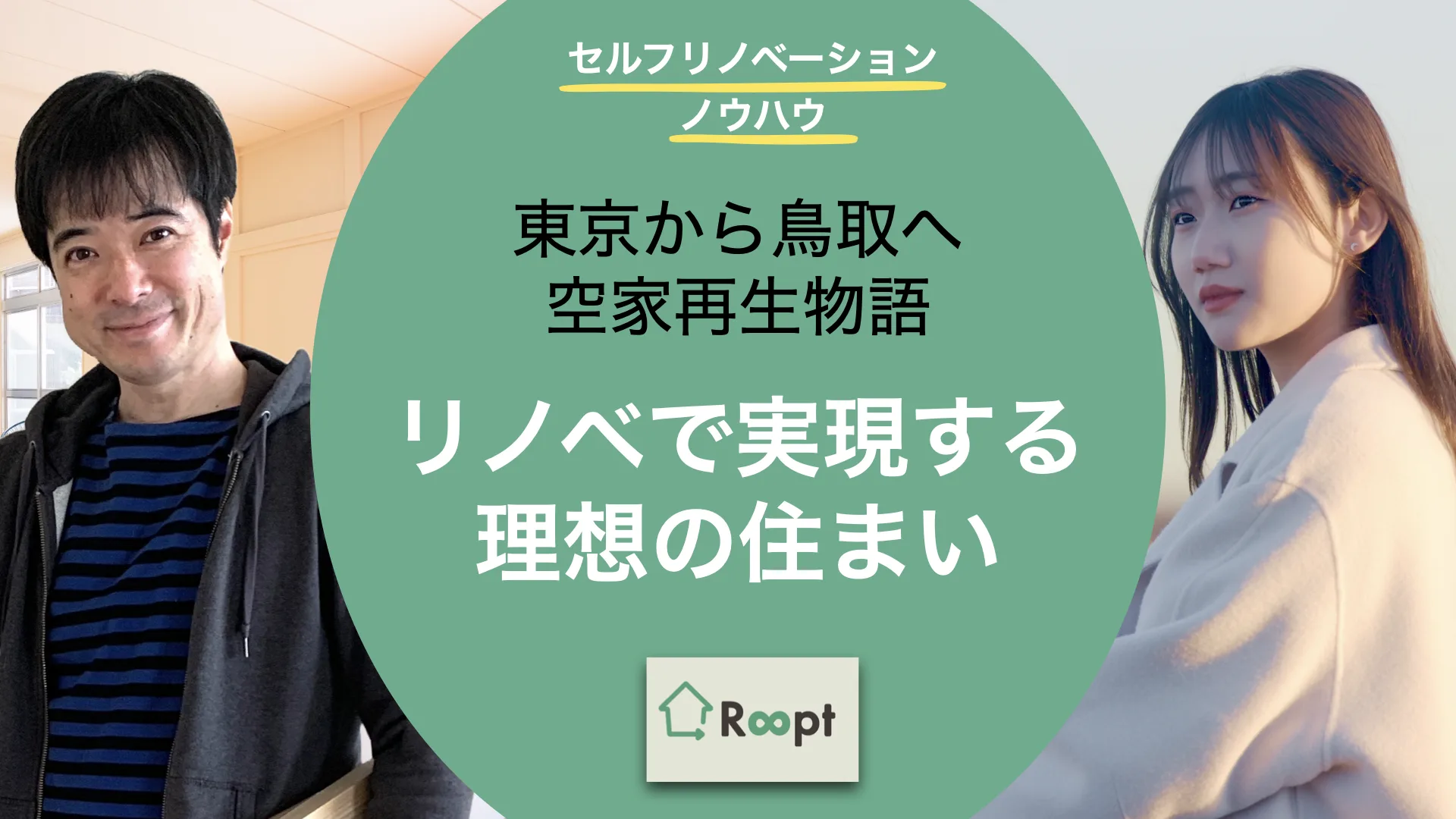
This article introduces the experience of a teleworking migrant who self-renovated an empty house. It covers the search for an empty house, the process of self-renovation, the costs and time involved, and the reasons why self-renovation is recommended.
Noi: Hello everyone, I'm Noi, the host of this channel. In this video, we've been discussing the evaluation of old detached houses for investment in modern times with Mr. Ueda from Gaiax. This time, we'll be interviewing Mr. Yoshii, who has actual renovation experience. Mr. Yoshii, thank you for joining us.
Yoshii: Thank you for having me.
Yoshii: First, I'd like to give a brief self-introduction. In 2017, when I got married, I moved from Tokyo, where I had been living, to Tottori. Now, I live in Tottori with my wife and child, a family of three. Both my wife and I work with computers and work from home. Neither of us has a daily commute, so we use our free time to self-renovate an empty house, which is where we live now. After that, we've been utilizing the extra space in our house to share it as a vacation rental and workspace.
Noi: You mentioned that you renovated your home. Where exactly do you live?
Yoshii: I live in Shikano-cho, Tottori City, Tottori Prefecture. This area has a large number of migrants, and empty houses have been utilized here for about 20 years now. It's a small town with about 3,400 people. There's a magazine for people who want to live in the countryside, and Tottori City has won first place in the category of "countryside where child-rearing families want to live." It's a very popular area for migrants.
Among these areas, Shikano-cho, Tottori City, is particularly active in utilizing empty houses, and many migrants gather here to rent and live in empty houses. There are many migrants and also many people returning to their hometowns, so the human relationships are very good. I moved here from another place, but I find it a very comfortable place to live, so if you are considering moving to a rural area, I hope you will consider Tottori City.
Yoshii: After moving, I initially lived in a rental, but then I ended up purchasing the empty rental house. Until then, when I was in Tokyo, I had always lived in rental properties, so I didn't really have any intention of owning or purchasing a house myself. However, after moving to Tottori, the owner of the rental house I was living in decided they wanted to sell the house itself. When I asked how much they would sell it for, the price was considerably higher than I had imagined, and I was wondering what to do. As I mentioned earlier, it's a very popular area for migrants, and properties nearby were being sold at quite high prices, so I thought it would be difficult to continue living there as it was. Also, living in a rental property isn't very stable, and I thought that owning a house when my son started elementary school would lead to a more stable life, so I started considering purchasing a house.
Noi: So, various circumstances led to your decision to move. We've heard about the background of your move and renovation. Next, I'd like to ask you more about the internal aspects of the renovation using an empty house.
Noi: Could you please tell us why you chose to renovate an empty house instead of building a new one?
Yoshii: There are two main reasons. The first is cost. I considered building a new house of the size I wanted, but it seemed like it would cost 30 to 40 million yen, even in the countryside, including the land. With an empty house, I thought I could buy the house itself for a few million yen and complete the renovation for around 10 million yen.
The other point is that from my experience living in an empty house as a rental, I thought that even empty houses or houses 40 or 50 years old could be made livable with simple renovations. The house I lived in had been empty for several years, so there was some mold, the interior was quite dirty, and the garden was very overgrown. However, after about two or three months of cleaning, and hiring professionals for kitchen and toilet cleaning, and also for wallpaper, it became quite bright inside and the atmosphere changed dramatically, even with a relatively simple renovation. So, I thought it would be fine to live there, and that was a factor.
Noi: How did you find the empty house itself?
Yoshii: Initially, I searched online using empty house banks and real estate sales websites. However, even searching across Tottori Prefecture, there were very few properties available. The ones that were listed were often like unsold properties that had been listed for many years. The real estate properties themselves were quite old, but the asking prices were unusually high, and there were only properties like that.
When I asked various real estate companies about the empty house sales situation, they said that since empty houses don't sell for very high prices, the profit they could earn from commissions was small, so real estate companies weren't very keen on handling them. Many empty house owners are elderly, and communicating with them can be quite difficult. If it were a condominium sale in Tokyo, everyone would be thinking about selling, so communication would be relatively easy. However, with the sale of rental properties, or rather, detached houses, most people aren't very accustomed to it, so real estate companies felt that it wasn't worth the effort to deal with it.
Finally, I was introduced to an NPO that promotes the utilization of empty houses in the region. Coincidentally, I found the empty house I now live in about 100 meters from where I was living at the time. While it might be possible to find empty houses online, there are very few of them, and many people are looking for those few properties. So, if you have a specific area you want to live in, I think it's best to consult with organizations or companies that support empty house utilization in that region.
: After finding the empty house, you mentioned that you self-renovated it. Could you tell us more about that, specifically why you chose to self-renovate instead of hiring a contractor?Yoshii
: The first reason is that when I tried to plan the renovation to meet my family's ideal, the initial budget, including the purchase price, was 10 million yen. However, the estimates from contractors were nowhere near enough. The house I live in now, before renovation, was a 5LDK with four Japanese-style rooms. We changed it to a 3LDK, converted everything to flooring, and updated all the plumbing. If I had asked for such a renovation, it felt like it would cost not 10 million, but more like 20 or 30 million yen, which would be almost like building a new house, so I realized it was impossible.After that, I was thinking of giving up on buying the house, but the NPO that introduced me to the house said, "If you have the motivation and time, and if you can compromise on the finished quality, self-renovation isn't impossible, so why not give it a try?" Since the NPO itself had various equipment and tools, and they offered to lend them, I decided to give it a try.
After that, I was thinking of giving up on buying the house, but the NPO that introduced me to the house said, "If you have the motivation and time, and if you can compromise on the finished quality, self-renovation isn't impossible, so why not give it a try?" Since the NPO itself had various equipment and tools, and they offered to lend them, I decided to give it a try.
Noi: I see. So, initially, you decided to self-renovate purely for financial reasons.
Yoshii: That's right. The budget I had in mind was completely insufficient.
Noi: So, you decided to self-renovate for cost reasons. Now that it's finished, how much did it actually cost?
Yoshii: Well, we started with a budget of 10 million yen. Initially, when purchasing the empty house, it was offered for 7.5 million or 8 million yen. However, considering the 10 million yen budget, that wouldn't leave much for renovation costs. So, after various discussions, we ended up purchasing it for 5.5 million yen. That amount is the total for the land and building, but it was almost the assessed value of the land.
As for other expenses, repairing walls and ceilings, flooring, plumbing, switching to new air conditioners, refrigerators, and since we went all-electric, installing an EcoCute water heater, plus a lot of trash disposal and such, it would normally have cost around 7 million yen. However, by utilizing various subsidies, we were able to keep it to about 4.5 million yen. The interior renovation is complete, but we're still planning to add a wooden deck, fences, and exterior painting. Including those future costs, my out-of-pocket expenses for the entire renovation will be around 10 million yen.
Noi: Wow, did it turn out as you expected?
Yoshii: Yes, it did. If there hadn't been subsidies, I would have had to compromise and lower the quality of various things. But because there were applicable subsidies, I was able to update various facilities and expand the painting areas.
Noi: I can imagine it must have been quite challenging doing it yourself. How much time did it take?
: My wife and I, with some help from our child, spent about a year on it. Both my wife and I work remotely from home, and the house we were living in was about 100 meters away from this house. So, after work, I would come to this house to do DIY, or paint a little during lunch breaks. We also used mornings, evenings, and weekends for the work.: My wife and I, with some help from our child, spent about a year on it. Both my wife and I work remotely from home, and the house we were living in was about 100 meters away from this house. So, after work, I would come to this house to do DIY, or paint a little during lunch breaks. We also used mornings, evenings, and weekends for the work.
It's a long and demanding process, and there are many monotonous hours. However, during those times, listening to audio content like Audible or Voicy can be a good distraction, even if it feels a bit tedious. So, over this past year, I listened to a considerable number of audiobooks and podcasts, which not only increased my DIY knowledge but also provided me with various other insights.
Noi: That's a great way to make use of your time, amazing!
Noi: You've shared a lot about the costs and time management of self-renovation, and I'm sure there's a lot to take in. If you were to recommend it, what would be your reasons for doing so?
Yoshii: Yes, there are two points. The first, as I've mentioned several times, is the cost. The ability to achieve the ideal facilities we want, even starting from an empty house, for about one-third the cost of a new build, is truly appealing.
The second is the improvement of DIY skills. As your DIY skills improve, you'll be able to modify your current room as needed in the future. My child is now six years old, and will soon be starting elementary school, so I'm thinking of creating a children's room soon. At such times, I might consider adding another room somewhere, or I might want to create a storage space for DIY tools. Recently, I've also started camping, so I'm thinking of building a small shed or something to store outdoor gear and tents. The advantage is that you can implement such changes without spending a lot of money.
Noi: It sounds like a lot of fun to be able to create a children's room or change your home freely according to your own wishes.
Yoshii: That's right. You can do various things according to your life stage, so in that respect, you gain various skills, and I think it's recommended.
Noi: Thank you very much. This time, Mr. Yoshii shared his experiences as a renovation veteran. Personally, I was very surprised at how much the costs could be reduced. In the next video, we will continue to interview Mr. Yoshii about renovation know-how. Thank you very much, Mr. Yoshii, for today.
Yoshii: Thank you.
First published: Akiya Lab (2024 - now integrated into this site)
FIND YOUR STAY
Feel free to contact us for inquiries about accommodation reservations, move-in consultations, viewing appointments, interviews, etc.
Contact Us